Why I’m building Fortiv
It wasn’t a discipline problem. It was an architecture problem.
I’m Harry, 44, one-person team behind Fortiv. Spring 2024, I reached for a pair of shorts I’d worn the summer before. They didn’t button. I told myself maybe they’d shrunk. They hadn’t.
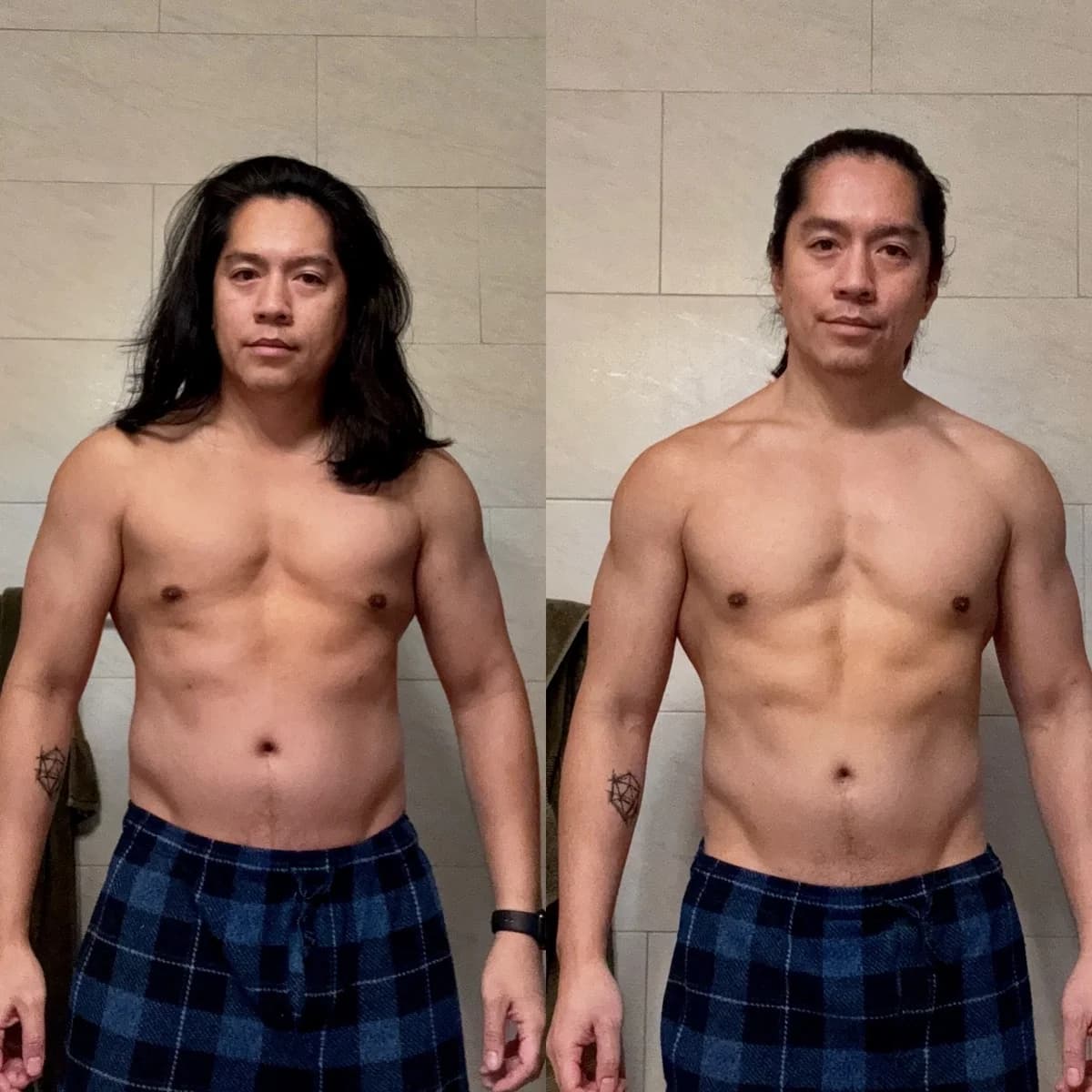
173 lbs → 162 lbs. Fourteen weeks. Beer and fried cheese included.
The shorts
The mirror lies to you. You see yourself every day, so the change never registers. It’s gradual and cumulative, and the mirror’s in on it. Pants don’t play along. A friend’s scale in Boston confirmed what the pants already knew: 178 lbs, the heaviest I’d been since 2008. I’d spent two months in Brooklyn eating and drinking my way through the neighborhood, training whenever the mood struck. Living life and calling it balance.
The mistake
A year earlier I’d tried to fix this, and made it worse. No body composition tracking, just a scale. Protein was a guess. When the number didn’t move, I cut calories. Then cut more. I lost weight and felt worse, because muscle went with it. Muscle is expensive to keep: your body sheds it first when training and protein don’t give it a reason to stay. Lose muscle, and your energy expenditure drops, which breaks the deficit the diet was built around, which makes you cut more, which costs you more muscle. That’s not a willpower problem. That’s a design problem with legs. I’d built a plan for a version of me who didn’t exist, then wondered why I couldn’t stick to it.
What changed
April 2025: I found zone 2 cardio and got strict: no drinking, no eating out, dead-consistent training and protein. It worked. By June I was the leanest I’d been as an adult. Then a friend came to visit. Dim sum, buffets, a week of undoing three months of habit, and I let it happen, because that’s what you do when a friend’s in town.
The lesson wasn’t about the food. A plan that only survives a life with zero variables in it isn’t a plan. It’s a streak. And streaks end.
That fall I ran a real hypertrophy block instead: structured training, eating enough to build, accepting I’d gain some weight back. By December I was heavier than June, carrying more muscle than I had at 178. And I finally understood what had gone wrong the first time.


Funny thing, I’ve got a photo from right around that 178 mark, mid-play, on stage. I remember looking at it afterward and blaming the lighting. Turns out the mirror wasn’t the only thing lying to me.
The receipts
14 weeks · Dec 2025 – Mar 2026
The number underneath the number: my lowest single day of the whole stretch was 159.9 lbs (week 12 averaged 162.0), the week my consistency peaked. Then real life showed up. Week 13 I was packing to move apartments. Week 14 was the move itself, plus my birthday week: restaurant meals, disrupted sleep, zero training precision. The scale climbed back up almost 3 lbs.
My weight, weekly average — 14 weeks
Weekly average of daily weigh-ins, Dec 4 2025 – Mar 16 2026 (baseline plus 14 weekly readings). Individual days ranged 159.9–172.8 lbs.
| Week | Average weight | Note |
|---|---|---|
| Week 1 | 171.5 lbs | |
| Week 2 | 170.0 lbs | |
| Week 3 | 167.7 lbs | |
| Week 4 | 168.4 lbs | |
| Week 5 | 167.3 lbs | |
| Week 6 | 166.9 lbs | |
| Week 7 | 166.2 lbs | |
| Week 8 | 166.2 lbs | |
| Week 9 | 165.1 lbs | |
| Week 10 | 166.0 lbs | |
| Week 11 | 164.5 lbs | |
| Week 12 | 162.0 lbs | lowest weekly average — peak consistency |
| Week 13 | 162.4 lbs | packing to move |
| Week 14 | 164.9 lbs | move + birthday week |
| Week 15 | 162.2 lbs | settling back in |
Here’s the part that matters: body fat % never went back up. It kept dropping through the move and the birthday cake: 17.7% in week 12, down to 15.7% by week 14. The scale reacted to water and restaurant food. My body composition didn’t undo itself in two weeks, because two disruptive weeks isn’t a trend. That’s the whole rule behind Fortiv: one bad stretch doesn’t erase the ones before it. You only act once the trend itself actually moves.
Beer most weeks. Fried cheese more than once. Training weeks I’d generously call light. Not one macro tracked precisely. The results didn’t happen despite the imperfection. They happened because the plan was built to survive it. The rule that made it possible: no changes until the trend holds for two full weeks straight. Not one bad day. The trend.
What I built
After those 14 weeks, I went looking for an app to keep running this. Couldn’t find one. Every app wanted precise tracking or a perfect streak, and the moment you slipped, it either flagged the miss in red or auto-adjusted your plan for you, which defeats the entire point of waiting for a real signal instead of reacting to one bad day. None of them had a category for showing up imperfectly and still winning. Odd, given that the people fighting this hardest, adults 35 to 55, are the group every fitness app still designs around ignoring.
So I built one, alone, and I’m still building it. Fortiv tracks your strength, your zone 2, and your adherence against your own plan. When you start to drift, it doesn’t hide it and it doesn’t panic on your behalf: it surfaces one lever to pull, and you decide whether to pull it. It never auto-adjusts anything without you. That’s the whole app.
Why trust the plan
I’m a NASM Certified Personal Trainer and CPR/AED certified: the program itself isn’t improvised. And before any of that, I spent almost 20 years building software. Fortiv’s adherence engine is built the way I’d build anything I expect people to depend on: tested, versioned, not vibes.
The journey, as it happened
Written in real time over 15 months, not reconstructed after the fact, the good weeks and the ones that fell apart:
- Apr 2025When Your Shorts Betray You: How I Discovered I Was 178 lbs & Started My Weight Loss Journey
- Apr 2025From Buying New Shorts to Buying a Stainless Steel Pan: My Absurdly Effective Weight Loss Upgrades
- Apr 2025From Donuts to Data: My Data-Driven Weight Loss Journey
- Jan 2026The Final Boss: December Fat Loss Experiment
- Jan 2026The Cost Curves of Fat Loss for Men 40+: An Engineering Trade-Off Analysis
- Feb 2026I Lost 12 Pounds in 12 Weeks by Stopping the Perfect Diet
- Mar 2026I Got Into the Best Shape of My Adult Life, Just in Time to Turn 44 — and I Have the Data to Prove It.
- Apr 2026The Levers I Never Had to Pull
- Jul 2026I Got Lean at 44 While Drinking Beer and Eating Fried Cheese. Here's the Rule That Made It Work.
Last month I put on the same shorts from 2024. They fit, looser, actually. The shorts didn’t change. I did, because this time I was honest about who I actually am on a Tuesday in February, not who I want to be on January 1st.
Sound like you?
download it. I’d rather have your feedback than your signup.
Download on the App StoreFollow along on Instagram or LinkedIn, or read more on the blog.