Bad Weeks Are Not Failures: The Math on Imperfect Fitness Adherence
The most common reason adults 35–55 quit fitness programs isn't lack of effort — it's reactive quitting after one bad week. Here's what the data shows about imperfect adherence, and why consistency over months beats perfection over weeks.
December 2025. I'm six weeks into a fat loss phase. It's the holidays — parties, drinks, meals I didn't plan for. One week I drank at three separate events. Training was whatever I could squeeze in between. By any streak-based metric, the week was a disaster.
I didn't change anything. Didn't cut calories. Didn't add cardio. Didn't restart.
Lo and behold: 14 weeks later, 9 lbs of pure fat gone, zero muscle lost.
Here's what I think happens to most people. You have a bad week. Maybe two. Training was lighter than planned, eating went sideways, life got in the way. And somewhere in week three, you decide the plan isn't working — restart next Monday, next month, after the holidays. The streak is broken anyway. What's the point?
That decision is the failure mode. Not the bad week itself.
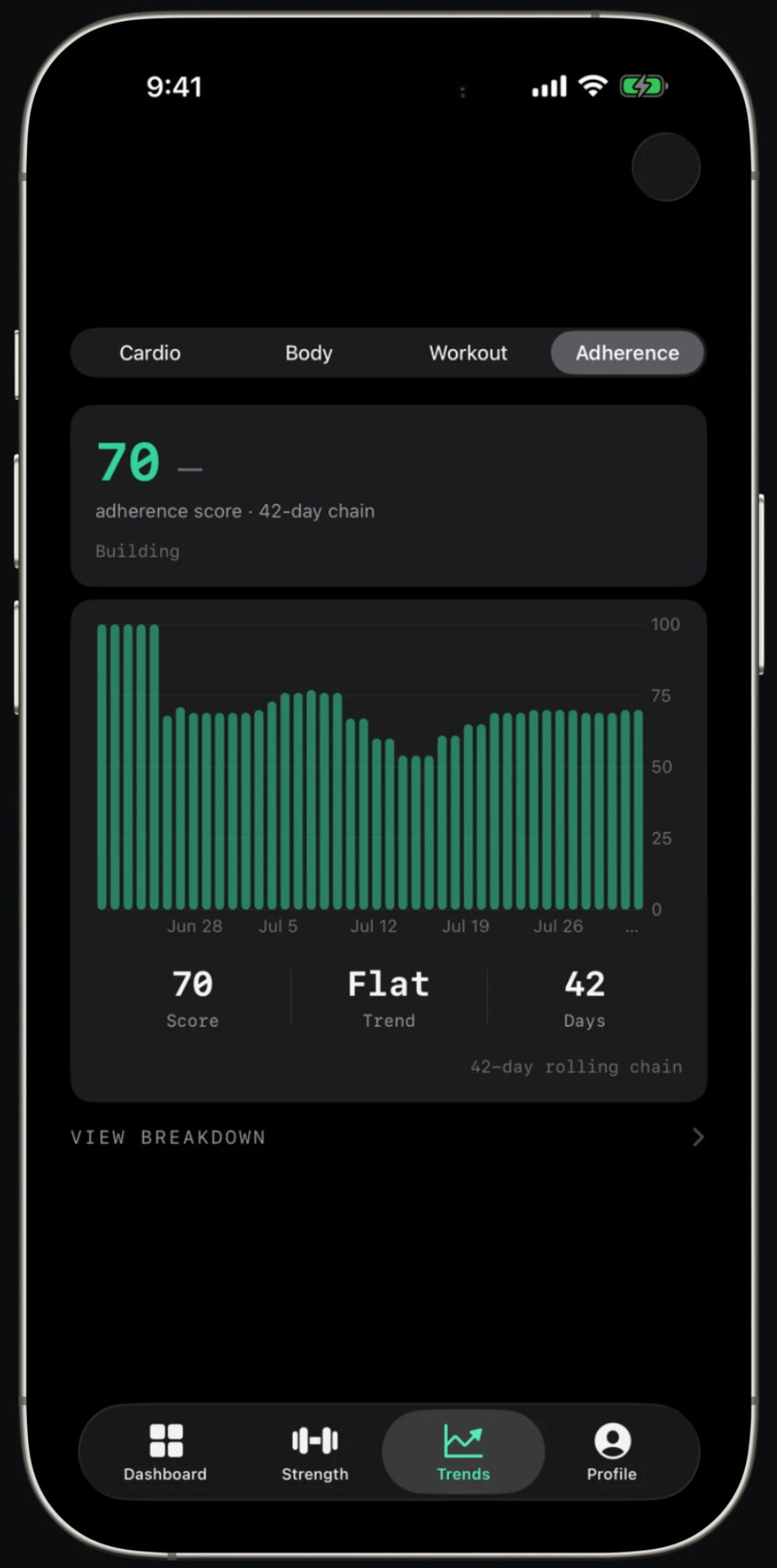
What does a bad week actually cost?
In a 12-week program, one bad week is 8% of the total time. If the 11 weeks before it were solid, that record doesn't disappear because week seven was rough.
For fat loss specifically: if you're averaging 0.5–0.75 lbs of fat loss per week, a maintenance week — no loss, no gain — costs you one week of progress. Not six weeks. Not the whole thing. The trend pauses. It doesn't reverse.
Rodrigues et al. (2020) tracked 437 gym members over six months using objective attendance records. The strongest predictor of future exercise adherence? Past behavior. Standardized coefficient of β = 0.92, explaining 85% of future variance.
Stated intention to keep going — how motivated you feel right now — had a coefficient of β = 0.04.
Think about what that means. The behavioral record you've built across months is 21 times more predictive of your future adherence than your current motivation level. One bad week moves a β = 0.92 variable by a fraction of a point. Your history is working for you whether you feel it or not. For the full habit-formation research behind that curve — including why the 21-day timeline is a myth — see what the science actually says.
What actually predicts future adherence
| Past behavior (6-month record) | β = 0.92 |
|---|---|
| Stated current motivation | β = 0.04 |
My 14-week data
Here's what actually happened between December 4, 2025 and March 16, 2026 — a period that included holiday parties, multiple weeks with alcohol, lighter training weeks, and zero precise macro tracking.
| Metric | Start | End | Change |
|---|---|---|---|
| Body weight | 173 lbs | 162 lbs | −11 lbs |
| Body fat % | 20% | 16% | −4% |
| Fat mass | 34 lbs | 25 lbs | −9 lbs |
| Lean mass | 127 lbs | 127 lbs | 0 lbs |
| Visceral fat index | 7 | 5 | −2 pts |
14 weeks — body weight and fat mass
| Body weight | 173 lbs162 lbs |
|---|---|
| Fat mass | 34 lbs25 lbs |
Nine pounds of pure fat. Zero muscle lost. At 44 years old. Who woulda thunk it.
The first week, the scale didn't move at all. A previous version of me would have panicked — cut more, added cardio, questioned everything. Instead: nothing. Early stalls in a fat loss phase almost always reflect water retention and glycogen response to new training load, not actual failure. I'd learned that lesson the hard way before.
By week four the trend was visible. By week fourteen, the table above.
The plan: five training sessions per week at maintenance volume, protein at every meal (eyeballed, not measured), zone 2 cardio after lifting, weekly average weigh-ins only. Nothing off-limits — just capped. The rule I held onto hardest: no plan changes until two full weeks of flat trend confirmed a real stall, not daily noise.
That's it. That's the whole system.
Which pattern is sabotaging you? Take the free 2-minute diagnostic
Why does reactive optimization fail?
The bad week isn't the problem. What you do after it is.
Reactive optimization is adjusting the plan in response to short-term data. The scale doesn't move for three days — cut more calories. Miss a few sessions — add cardio. One rough week — restructure everything.
It feels productive. It's the opposite.
Every change disrupts the signal. Fat loss data needs two to four weeks to clear the noise from water retention, glycogen, hormones, salt. When you change the plan after three flat days, you've eliminated your ability to know if the original plan was working. Now you're running a new experiment without enough data from the first one. When that doesn't immediately move the scale, you change it again.
Most people who've repeatedly failed at fat loss aren't bad at losing fat. They're reactive optimizers. They haven't waited long enough to see the evidence of what was actually working.
Two-week rule: no plan changes until two consecutive weeks of flat trend. Not two bad days. Not a week that felt hard. Two full weeks.
What does tracking actually do?
Burke et al. (2011) reviewed 22 studies on self-monitoring and weight loss. Self-monitoring — tracking diet, exercise, or body weight — correlated with better outcomes in every single study. Not most. All 22.
More frequent monitoring predicted better outcomes than less frequent monitoring. The correlation between food diary submissions and weight loss held at 18 weeks and at 52 weeks.
Tracking isn't just record-keeping. It's an adherence mechanism in itself. The act of logging a workout — even a lighter-than-planned one — produces better outcomes than not logging it. You don't need perfect entries. You need consistent ones.
This matters for how you read a bad week. Logging the bad week and continuing is self-monitoring. It's associated with better outcomes. Quitting and restarting is a different behavior entirely.
Weekly averages, not daily readings
Daily weight fluctuates 1–3 lbs for reasons that have nothing to do with fat: sodium, hydration, glycogen, hormones, digestion. A Monday reading vs. a Friday reading in the same week aren't comparable.
Weekly averages cut through most of that noise.
During December — holiday party weeks, multiple nights out — individual daily readings would have triggered every reactive change in the book. The weekly averages showed steady decline the whole time.
That's also why the two-week rule works. Weekly averages go in, not daily fluctuations. Two consecutive flat weekly averages is real signal. Two consecutive bad daily readings is noise.
The first six months are the whole game
Rodrigues also found that roughly 50% of all dropout from exercise programs happens in the first six months. After that window, attrition stabilizes sharply.
The six months aren't just when dropout is highest — they're when the behavioral pattern is establishing itself. The record you're building during imperfect weeks is the dominant predictor of your future adherence. Showing up lighter. Logging it anyway. Not treating a bad week as a reason to restart.
That's what builds the β = 0.92 variable that carries you forward.
A plan that only works when life cooperates isn't a plan. It's a streak. Streaks end. Build the plan around who you actually are — on a Tuesday in a demanding work period, during a week with travel, in December — and it survives long enough to produce results.
Fortiv's Adherence Engine tracks consistency as a trend across strength, zone 2 cardio, and overall adherence. It flags when drift is measurable across multiple weeks — not when a single session is missed. It doesn't auto-adjust the plan in response to a bad week, because the two-week rule exists for a reason.
For the research on why the first six months are the highest-risk window — and what design decisions cause the predictable quit — see Why Every Fitness Routine You've Started Has Failed (It's Not You). For the specific month-4 data, see Why You Quit Your Fitness App in Month 4.