Why You Quit Your Fitness App in Month 4 (The Research Is Embarrassing)
Most fitness app users quit around month 4. This isn't a willpower problem — it's a product design problem. Here's what the research says, and what an app built for real adherence looks like.
The majority of people who download a fitness app will stop using it before the four-month mark. Not some — most.
This isn't a fringe outcome. It's so consistent and predictable that a 2021 research team built a model to forecast it. They trained it on the first 90 days of user behavior and achieved 87% accuracy in predicting whether someone would still be active in month 4. They published the result. The industry has seen this data.
The apps haven't changed.
Key findings:
- 54% of fitness app users show zero training activity by month 4 (Jossa-Bastidas et al., 2021, n=246)
- Month-4 adherence is predictable from months 1–3 behavior alone, at 87% accuracy
- Past behavior — not motivation or intention — explains 85% of future adherence (Rodrigues et al., 2020, n=437, β=0.92 vs. β=0.04)
- Self-monitoring correlates with better adherence in all 22 studies reviewed (Burke et al., 2011)
- The pattern is a design problem, not a willpower problem — see below
The month-4 cliff is documented — and predictable
Jossa-Bastidas et al. (2021) analyzed usage data from 246 actual fitness app users — not clinical trial participants, but real users with real accounts and self-selected goals. By month 4, 134 of them — 54% — had zero training activity. The researchers trained a deep learning model on months 1–3 behavior and predicted month-4 adherence with 87% accuracy and an F1-score of 85%.
Fitness app users still training at month 4
| Zero activity by month 4 | 54% — 134 of 246 users |
|---|---|
| Still training | 46% |
Month-4 adherence isn't an unpredictable variable. It's a downstream consequence of early behavioral patterns. The trajectory is visible within the first three months.
Cadmus-Bertram et al. (2014) documented the same arc in a 12-month exercise study with 100 adults between the ages of 40 and 75. The pattern held across the full sample: adherence ramps in months 0–3, peaks in months 4–6, then declines. All seven participants who dropped out entirely did so after the three-month mark. No one quit in month one or two — they quit after they had already built something, then watched it erode.
This is not a pattern driven by individual willpower variance. It's a predictable arc with a consistent shape across studies, demographics, and formats.
What incentive problem doesn't the industry discuss?
Fitness apps optimize for early engagement. That's what drives App Store ratings, what gets featured in fundraising decks, and what determines month-one retention — the metric that most investors and platform algorithms care about.
Streaks, daily completion badges, intensity leaderboards, and challenge frameworks are effective at one thing: generating engagement in the first 30 days. They are not designed for month four, because they create an environment where a single missed week registers as complete failure rather than a minor deviation from a longer trend.
The misalignment is structural. The app's commercial success metrics and the user's actual health outcomes are different things. A user who builds durable training consistency over eight months — with a messy first month — is far healthier than one who maintains a perfect streak for six weeks and then quits. But only the second user generates the short-term retention that shows up favorably in product dashboards.
The research on long-term dropout is not proprietary or obscure. Multiple teams have published it. The design changes that would reduce month-4 attrition are identifiable. They haven't been widely adopted because the features that produce good long-term adherence don't optimize for the metrics that drive early growth.
Which pattern is sabotaging you? Take the free 2-minute diagnostic
What actually predicts whether you'll stick?
Rodrigues et al. (2020) tracked 437 gym members using objective attendance records over six months. The strongest predictor of future exercise adherence was past behavior, with a standardized coefficient of β = 0.92. That single variable explained 85% of future adherence variance.
Stated intention to keep going — what you tell yourself about your commitment — had a coefficient of β = 0.04. Intention barely registers as a predictor compared to the behavioral record you've already built.
This finding has a specific implication for how to interpret your own training history. If you've been training for three months — even imperfectly, even inconsistently — that history is now a stronger predictor of your future than your current motivation level. The behavioral record is working for you, and one bad week doesn't erase it.
Rodrigues also found that approximately 50% of all dropout occurs in the first six months, after which attrition rates stabilize sharply. Getting past that window is the milestone that matters most. After it, behavioral momentum largely takes over.
Why does session completion matter more than duration?
One of the clearest findings from Jossa-Bastidas involves what type of behavior actually predicts adherence. The answer is not what most fitness apps measure.
Session completion — whether the user finished a workout, independent of how long it was — was a stronger predictor of long-term adherence than session duration. The best-performing model combined missed sessions per month, mean session time, and weekly session patterns. Duration alone was a weaker signal than whether you showed up and finished.
Practically: a 20-minute session completed consistently predicts better outcomes than a 60-minute session done sporadically. Apps that measure success in total minutes trained, or that frame a 20-minute session as partial credit, are tracking the wrong variable. Finishing is the metric. Duration is secondary.
Jossa-Bastidas also found that session completion — not duration — was associated with mood improvement in users. The psychological reward from a completed workout comes from finishing, not from how long it ran. A system that celebrates completing a short session produces better behavioral reinforcement than one that penalizes you for not hitting a duration target.
What design choices produce the month-4 quit?
Most major fitness apps share a set of design patterns that appear to be engagement features but function as adherence destroyers for adults with real schedules and real lives.
Streak systems treat each missed day identically: the streak resets, you start over. For someone managing a demanding work period, a family obligation that consumed the week, or travel that made consistent training genuinely impossible, this framing converts a missed week into a perceived failure. Research on habit formation from Lally et al. (2010) found that missing a single day produced less than half a point drop in habit automaticity and full recovery by the next session. The streak model punishes what the research identifies as inconsequential.
Intensity-as-success metrics push users toward harder sessions: more calories burned, harder workouts, new personal records. After 40, intensity is the variable that requires the most careful management, not maximization. An app that celebrates "hardest workout this month" without accounting for recovery or accumulated fatigue is measuring the wrong thing and reinforcing behavior that elevates injury risk.
Perfect-plan design builds programs around idealized weeks that assume a stable schedule, adequate recovery, and minimal disruption. For adults 35–55 whose careers are at peak load and whose family schedules are structurally inflexible, the idealized week is the exception. When real life disrupts the plan — and it will — these apps have no graceful response. The streak is gone, the program is off-track, and the user interprets that as personal failure.
Shame-based re-engagement — the "you've been away for a while" push notification, the streak grief prompt, the challenge reminder you failed to complete — converts a temporary absence into a psychologically costly return. Self-determination theory research identifies these as controlled motivation triggers: externally applied pressure that produces short-term compliance and long-term dropout. The user who felt guilty about a missed week now has the app confirming it.
What does the research say actually works?
The evidence on effective adherence design isn't particularly complicated — but it requires accepting that the metrics worth optimizing are different from the ones that look good in dashboards.
Self-monitoring. Burke et al. (2011) reviewed 22 studies examining self-monitoring's relationship to weight loss and adherence. Self-monitoring correlated with better outcomes across every study in the review — no study found the opposite. The effect held regardless of format: paper diaries, digital logs, and app-based tracking all showed similar associations when used consistently. More frequent monitoring predicted better outcomes at 18 weeks and at 52 weeks. Logging a workout isn't just record-keeping. It's an adherence intervention. For the full framework on what this looks like in practice, see Why Every Fitness Routine You've Started Has Failed.
Trend tracking over streak tracking. Rodrigues' finding — that past behavior (β = 0.92) explains 85% of future adherence — suggests that the summary statistic worth monitoring is training consistency over months, not perfect execution over days. A single bad week barely registers when you're measuring a 12-week trend. A system that shows you the trend rather than holding a daily streak over your head is more accurately representing what actually matters. For the math on what a bad week actually costs, see Bad Weeks Are Not Failures.
Session completion as the success signal. Finishing matters more than how long it took. A system that logs a completed 20-minute session the same way it logs a completed 60-minute session is better calibrated to the evidence than one that rates them differently.
Proactive support before the drift window. Cadmus-Bertram's trajectory data makes the four-to-six month mark identifiable in advance. Reinforcing consistency during that window — before the decline shows up in the data — is better-timed than reactive intervention after dropout has already occurred.
Why do adults 35–55 experience this differently?
For younger users, a month-4 quit is an inconvenience — another app tried, another one discarded.
For adults who have tried and quit multiple fitness programs over the years, each quit compounds. It doesn't register as evidence that the app failed. It registers as evidence they can't do it. The design produced the outcome, and they internalized the attribution.
Adults 35–55 are also operating under more structurally constrained conditions. Careers are at peak load. Family obligations are real and often inflexible. Travel is a regular input, not an occasional disruption. An app designed around idealized weeks will collide with their actual lives more frequently — and more consequentially — than it would for a 25-year-old with a flexible schedule and fewer commitments. For more on why the structural mismatch runs deeper than design patterns, see why the fitness app industry was built for a different demographic.
The self-determination theory literature adds another dimension. Adults 35–55 who train for longevity, functional capacity, and long-term health are exactly the profile for what researchers call autonomous motivation — training because they want to, grounded in values that are genuinely their own. Fitness apps that layer streak pressure, intensity competition, and shame-based nudges on top of that intrinsic motivation are actively undermining it. Controlled motivation produces early engagement. Autonomous motivation produces the kind of consistency that holds across years.
What does adherence-first design look like?
An app designed for long-term adherence inverts most of the standard design choices.
Trends replace streaks. A missed week doesn't erase a solid month — and the summary statistic the user sees should reflect that. Training consistency measured across three months is accurate signal. A streak counter that resets after a missed Friday is noise that distorts how you interpret a good month.
Session completion becomes a first-class success signal. The system treats a finished 20-minute workout the same way it treats a finished 60-minute one: as evidence of adherence, not as partial credit.
The plan doesn't auto-adjust in response to short-term misses. Reactive changes — cutting calories further, adding cardio, restructuring the week after two bad days — introduce more instability than they resolve. Stability during imperfect weeks is the correct response to life interference.
Support is proactive rather than reactive. The four-to-six month window is identifiable from prior-month patterns. Reinforcing someone's consistency during that window is better-timed than alerting them after they've already stopped.
Fortiv's Adherence Engine is built around these principles. It monitors training across strength, zone 2 cardio, and overall consistency — tracking trend data rather than daily streaks. It surfaces warnings when drift is measurable, without penalizing imperfect execution or auto-adjusting the plan in response to a difficult week. A warning is information, not judgment.
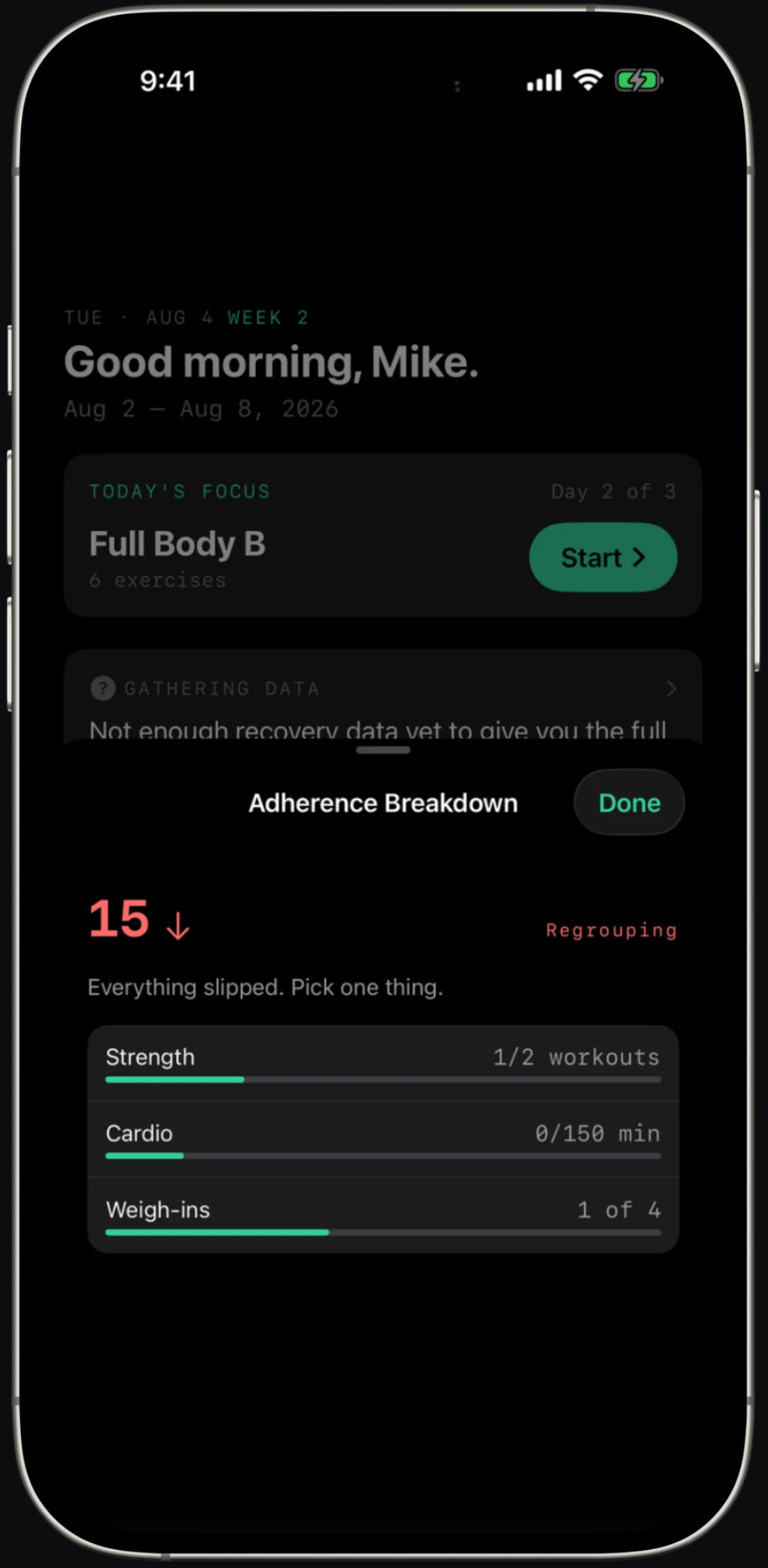
If you've quit fitness apps before and assumed the problem was you, the research suggests otherwise.
For a broader look at how the incentive structures behind the fitness app industry shaped what got built — and who it was built for — see Why Fitness Apps Are Built for 25-Year-Olds, Not 40.